
Today is Stonewall's Rainbow Laces Day, and we're delighted to be partnering with them.
Bolt Insight partners with Stonewall on Rainbow Laces Day
Sport should be one of the easiest places to belong. You turn up, you play, you cheer.

Robbie Lees
Digital Marketing Manager
.jpg&w=2560&q=75)
But for many LGBTQ+ people it's still somewhere you check who's around before you let yourself relax.
What we did
Stonewall asked us to hold in-depth conversations with LGBTQ+ people aged 19 to 61 who play or follow sport. Every conversation was one-to-one, and every one was AI-moderated.
When you've spent years managing who's watching, a conversation with no one to perform for can feel very different. That's the idea behind AI-moderated research. Without a human audience, there's no social performance to maintain, and people tend to say what they actually think and feel.
Participants joined with informed consent and all quotes are anonymized, in line with our ethical AI principles.
What we heard
People described movement as vital for their mental and physical wellbeing. One 27-year-old said it "allows my mind to quiet down." But in mainstream settings, many said the price of taking part is hiding who they are. A 59-year-old who joined a local men's football team told us he put on "a more macho front" and ended up "lying to myself and others."
Alongside our interviews, Stonewall's new survey data shows the scale of the problem. One in nine LGBTQ+ people (11%) avoid the gym, exercise classes or sports groups for fear of discrimination. Among trans+ people it's 29%.
Our participants were clear about what would help: anti-discrimination policies that are properly enforced, simple ways to report abuse, private changing facilities and more visible LGBTQ+ role models, especially in elite men's sport. They value Rainbow Laces as a sign they're welcome. They also want clubs, governing bodies and brands to back it with action all year round.
Why the conversation mattered
The gap between what people feel and what they feel safe to say sits at the heart of The Honesty Gap, our original research on football and LGBTQ+ inclusion.
Across 3,000 survey respondents, 89,500 social media mentions and 150 AI-moderated interviews, we found that 92% of fans agree a footballer should feel safe to come out and 89% say they'd be comfortable if a player at their club did. Yet only 28% believe other fans feel the same way.
A tolerant majority, and nobody saying so. We've already shared these findings with the research community at Quirk's New York, and working with Stonewall is the next chapter in the same conversation.
Simon Blake OBE joins us at Bolt Summit
Stonewall will be with us at Bolt Summit on November 12 in London, and we're thrilled that their Chief Executive, Simon Blake OBE, will be the one joining us.
Simon has been a clear voice on what real inclusion takes, and we can't wait to hear his perspective alongside our research community.
 Latest articles
1 Oct 2026
Introducing IQ: Your Always-On Research Assistant
We've always believed that great insight should be fast, deep and easy to act on. IQ is the next step in making that real.
Robbie Lees
Digital Marketing Manager

28 Sept 2026
Bolt Insight at Le Printemps des études 2026
Last week, the Bolt Insight team headed to the Palais des Congrès in Paris for Printemps des Études, one of the most important events on the French market research calendar.
Robbie Lees
Digital Marketing Manager
21 Sept 2026
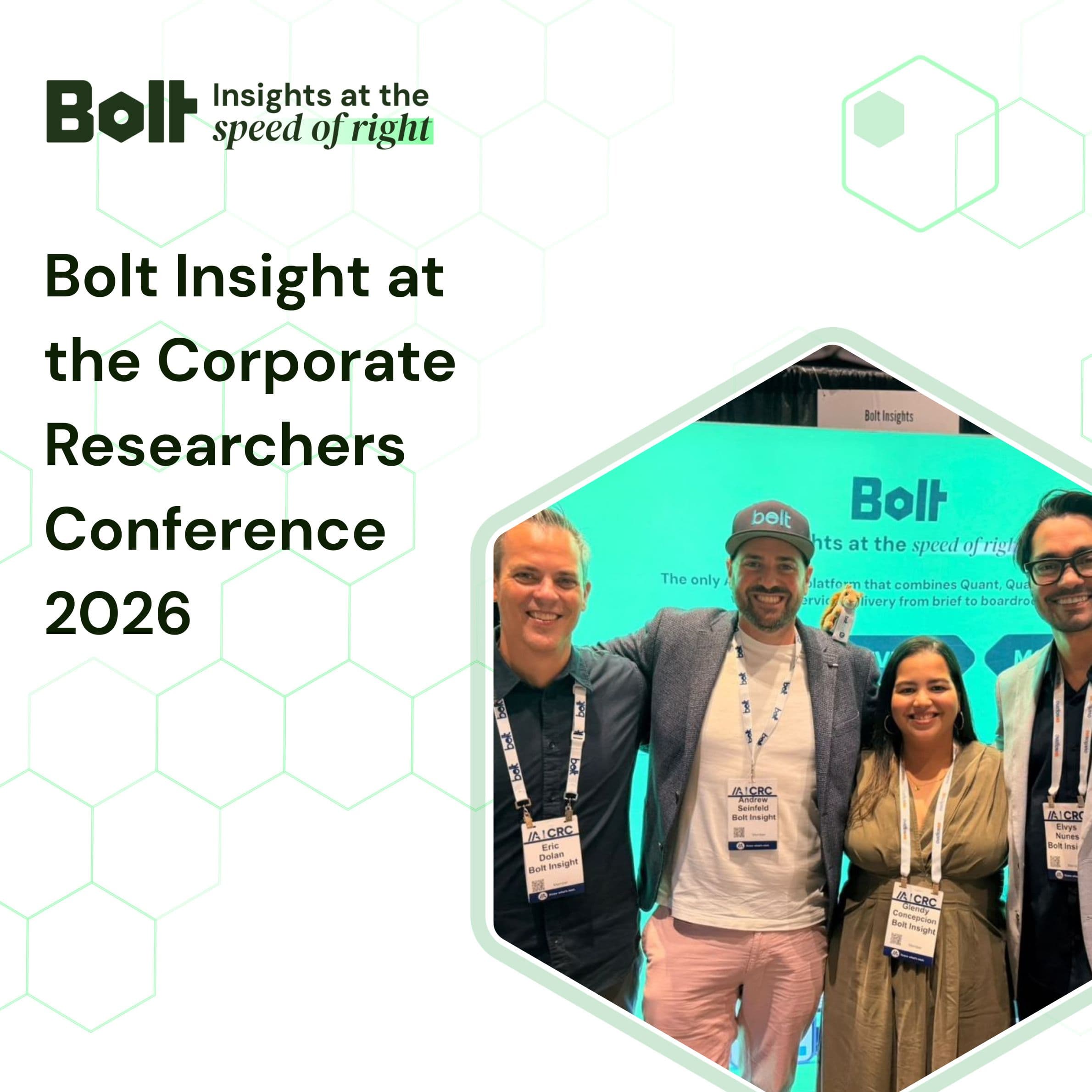
Bolt Insight at the Corporate Researchers Conference 2026
Bolt Insight at the the Corporate Researchers Conference in Chicago, hosted by the Insights Association.
Robbie Lees
Digital Marketing Manager