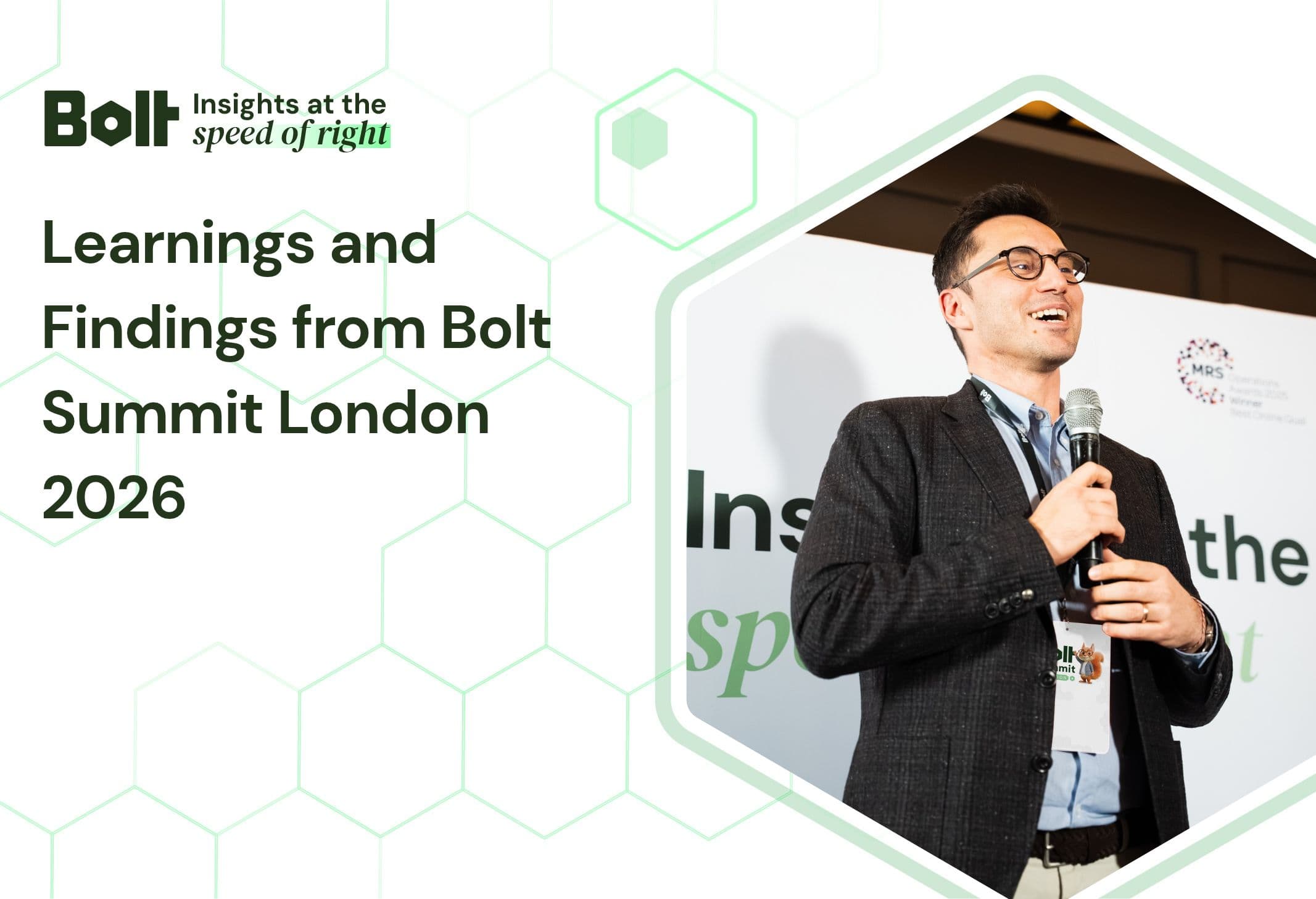
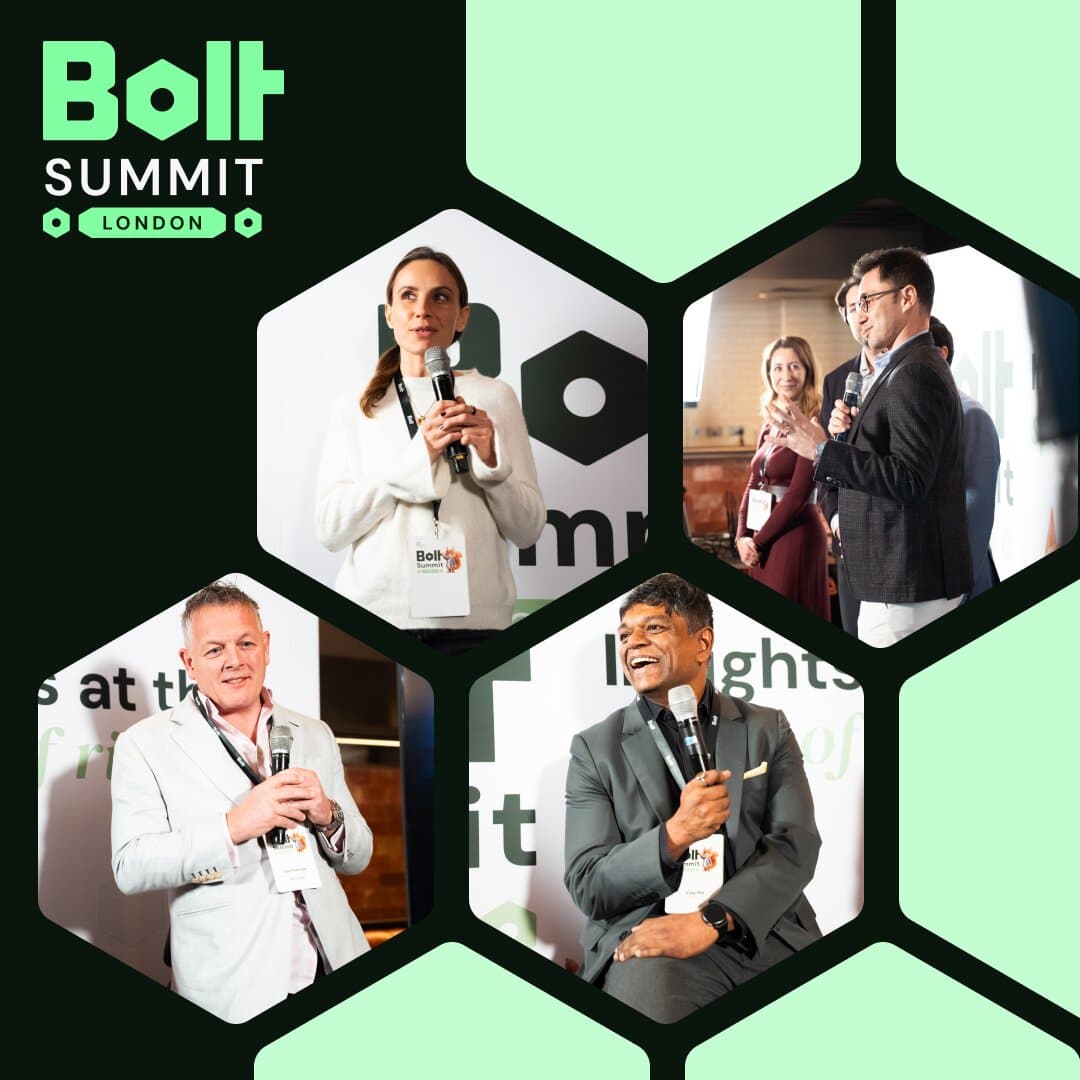
Before the doors opened at Bolt Summit London 2026, we asked attendees a few questions about the thing the whole industry is quietly wrestling with…
What do insight professionals actually think AI will do to their world?
We were not looking for the polished ‘correct’ answer. We wanted to understand what they honestly think about AI in consumer insight. Using AI-moderated conversations via Bolt Intelligence, we gathered responses from insight professionals ahead of the event.
The findings landed on stage during the day and sparked some of the most engaged conversations of the afternoon.
Three themes ran through almost every response… here is what they told us.
Theme 1: Efficiency with risk
Participants broadly agreed that AI will increase the volume and speed of research. But a significant number flagged the same concern: that efficiency gains could come at a cost.
As one participant put it:
“"There is a risk it makes insights teams dumber, assuming AI knows the answer and can accurately summarise insights and what they mean."
”
The concern is not that AI will replace researchers. It is that over-reliance on AI outputs could quietly erode the interpretive skills that make research valuable in the first place. If teams stop doing the hard thinking because the AI has already summarised the findings, something important gets lost.
Theme 2: The irreplaceable value of deep qualitative research
Several participants pushed back strongly on the idea that AI can replicate the depth of ethnography, in-depth interviews and face-to-face human connection. The nuance, the cultural context, the trust that builds in a real conversation. These were described as things automated data retrieval simply cannot replicate.
This does not mean AI has no role in qualitative research. It means the conditions of research still matter enormously. The best AI-moderated research is not about replacing human depth, it is about creating space for consumers to share what they really feel.
Our own Honesty Gap research is a good example. By removing the human interviewer from the conversation, we were able to surface a 77-point gap between what football fans said they believed about LGBTQ+ inclusion and what they actually felt when given the conditions to be honest. That finding could not have come from a survey alone.
Theme 3: From data collection to strategic impact
The most optimistic responses came from professionals who saw AI freeing insight teams to focus on the now what rather than the what. If AI handles the mechanics of data gathering and synthesis, the human role becomes more strategic, more valuable and closer to the boardroom.
As one respondent noted:
“"AI will make insight teams more impactful as they can spend more time on the 'now what' rather than collecting the data."
”
This is the version of the future most respondents want to see. Not AI replacing researchers, but AI doing the heavy lifting so researchers can do what they do best.
The tension nobody talks about
Across the responses, one frustration surfaced repeatedly that had nothing to do with AI at all. The relationship between insight teams and the stakeholders they serve.
Several respondents described a persistent gap between what they know good research requires and what the business actually wants. Depth, nuance, the kind of contextual understanding that takes time to build, up against stakeholders who want faster outputs, simpler answers and less involvement in the process.
As one participant put it:
“"If financially responsible stakeholders don't have skin in the game on the research question or business issue upfront, they won't respect the results or the work enough to give it deserved attention. So get involved at the question stage to see the value.”
”
Another noted that two people can look at the same data and reach completely different conclusions, and that the human judgment required to navigate that is exactly what gets undervalued when speed becomes the only metric.
This is not a new tension. But AI has sharpened it. When the promise of AI is faster, cheaper research, the risk is that stakeholders hear faster and cheaper and stop asking about the quality of what sits underneath.
What this means for the industry
What came through clearly across these responses is that the industry is moving past the question of whether to use AI and into something far more interesting. How to use it well. Where human judgment remains irreplaceable. What the insight professional's role looks like as the two find their balance. And crucially, how to bring stakeholders on that journey rather than leaving them behind.
These are not simple questions and there are no clean answers yet. But the fact that insight leaders were willing to sit with an AI moderator before a conference and share their honest, unfiltered views on the most contested topic in their industry tells you something. The conversation is maturing. The defensiveness is dropping. People are ready to get specific.
Want to see AI-moderated research in action?
The Honesty Gap is Bolt Insight's original research into LGBTQ+ inclusion in professional football, using AI-moderated interviews to surface findings that traditional research missed entirely. You can download the full whitepaper here.
Or if you want to understand what Bolt Intelligence could do for your organization, you can book a demo with the team at a time that suits you.